The useful question is not “Is my SEO good?” It is “Does this page provide the basic signals a crawler needs to identify, understand and consolidate it?” The Millwards Online SEO category answers that narrower question with visible evidence.
What this small-business SEO audit can answer
A search result begins with a crawlable page that explains itself. The title should name the page rather than repeat a vague slogan. The description should give a useful summary. One clear primary heading should align with the visible subject. A canonical address should identify the preferred version when duplicate routes exist.
Those signals do not create rankings by themselves, but missing or conflicting signals can make an already difficult job harder. This audit identifies whether defined foundations are present in the HTML and response returned at scan time. It is particularly useful after launching a page, changing a content-management-system template, moving domains or noticing that search snippets look unhelpful.
The scanner also checks whether the page declares a noindex instruction and whether standard crawler discovery files can be found. That can uncover obvious accidental blocks, but it cannot confirm that Google has crawled or indexed the page. Only the relevant search platform and its webmaster tools can show that state.
The on-page SEO checks included
- Search-result titlePresence and a working length range of roughly 10–60 characters.
- Meta descriptionPresence and a working length range of roughly 50–160 characters.
- Primary headingWhether exactly one detectable
h1identifies the visible page subject. - Heading orderWhether headings follow a coherent hierarchy without obvious level jumps.
- Indexability directiveWhether a detectable robots instruction tells search systems not to index the page.
- Canonical URLWhether a preferred page address is declared in the document head.
- Structured dataWhether JSON-LD is present, including a separate observation for LocalBusiness types.
- Open Graph basicsWhether core title, description and image-sharing metadata can be detected.
- Robots.txtWhether the standard root crawler-instruction file is publicly discoverable.
- XML sitemapWhether a standard root sitemap is discoverable; its full URL inventory is not audited.
The title and description ranges are consistent diagnostic thresholds, not universal laws. Search engines can rewrite snippets, truncate text differently by device and use other page signals. A description outside the range may still be useful, and one inside the range can still be weak or inaccurate.
If a business name and town or service area are supplied in the optional audit fields, separate content and trust checks look for those terms in visible copy. That is a simple consistency signal—not local keyword research, Google Business Profile analysis or proof that location pages are appropriate.
What the report shows and how SEO is scored
The free snapshot includes the overall audit score, the separate search-category score and public detail for the page title and meta description. It also shows neutral counts for additional locked findings. The £29 complete report unlocks every detected finding, its status and severity, the evidence returned, likely impact and a practical recommendation.
Each rule receives a fraction from zero to one and a weight from 1 to 8. The search category is the weighted average of its applicable rules. The title carries more influence than a lower-impact enhancement because it is a foundational identifier. The category then contributes to the overall website score alongside technical, content, trust, accessibility and performance rules.
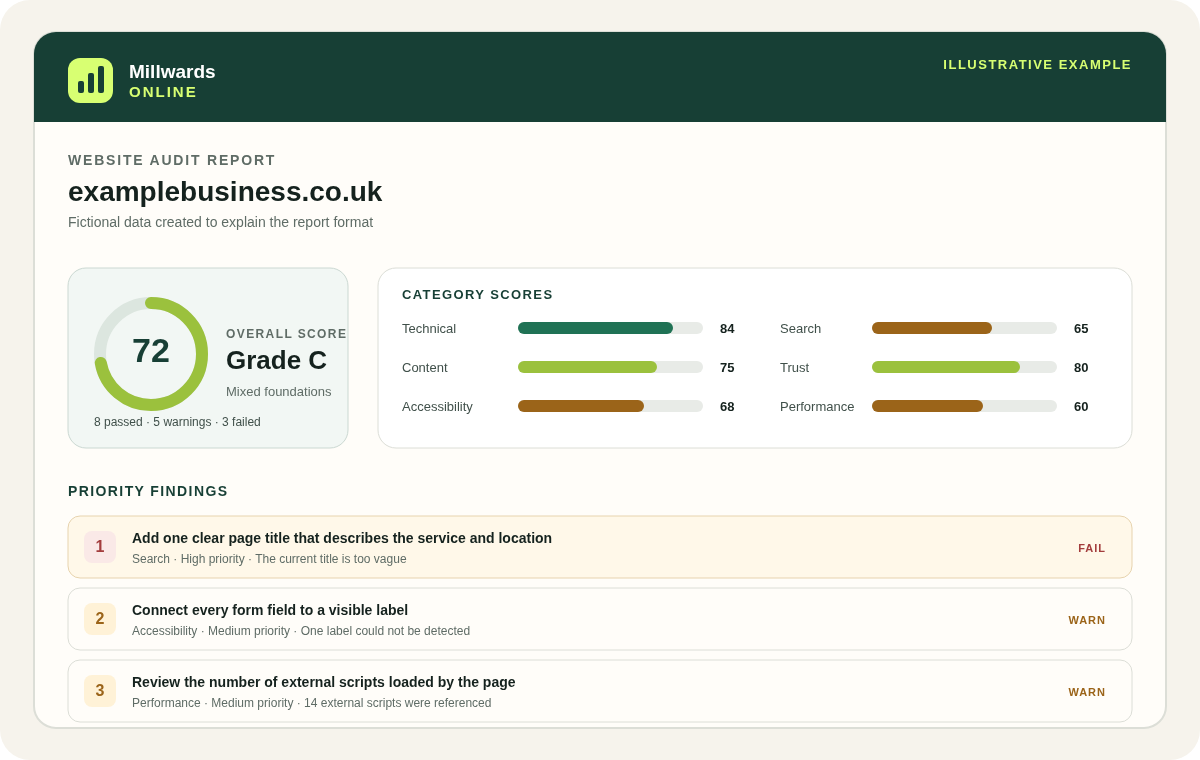
The illustrative report walkthrough shows how a search finding appears beside the other categories. The published scoring method explains the pass, warning and fail boundaries in detail.
What is not measured in this automated SEO audit
This is not a ranking or whole-site SEO service. A high search-category score means good coverage of these defined page signals, not that a page is indexed, competitive or likely to rank for a chosen query.
- No live ranking data: the scanner does not query Google results or estimate positions.
- No Search Console access: impressions, clicks, coverage, crawl history and manual actions are outside the audit.
- No keyword research: it does not decide which services, locations or questions people search for.
- No backlink or competitor analysis: authority, references, link quality and competing pages are not compared.
- No complete site crawl: the submitted page is primary, so duplicate, thin or orphaned pages elsewhere may remain unseen.
- No human quality judgement: a title can fit the length range while still being unpersuasive, repetitive or aimed at the wrong intent.
- No guarantee of indexing: a sitemap and indexable directive help discovery, but a search engine chooses whether and when to index a page.
JavaScript-rendered content, consent states, bot protection and location-specific responses can also affect what the server-side parser sees. Always compare the report evidence with the live page before changing it.
How to use the SEO findings
- Confirm that the report reached the intended final URL and did not stop on an error or protection page.
- Fix direct conflicts first: an accidental noindex, incorrect canonical, failed status or long redirect path can undermine other work.
- Make the page title, description and primary heading specific to the real page purpose. Avoid copying the same text across every page.
- Keep structured data truthful and supported by visible content. Do not add ratings, FAQs or locations that the page does not actually provide.
- Check internal links and the sitemap point directly to the preferred canonical URL.
- After changing the page, run another audit and use the appropriate search platform tools to inspect indexing separately.
For ongoing detection of changes to these audit signals, the monthly monitoring plan rescans the authorised domain and supplies refreshed findings. It is not rank tracking, but it can show when an audited signal changes between scans.
Small-business SEO audit questions
Does the SEO audit check Google rankings?
No. It checks detectable on-page search foundations in the submitted page and standard discovery files. It does not connect to Google Search Console, read live rankings, analyse backlinks or compare competitors.
Is this a whole-site SEO audit?
No. The submitted public page is the primary subject, with limited robots.txt and sitemap discovery. A whole-site crawl, keyword research and manual content review require a broader SEO process.
Can a good SEO category score guarantee more traffic?
No. A good score means the page covers the defined detectable rules well. Demand, competition, page quality, links, index status, reputation and many other factors affect search visibility.